
Where Commitments Take Root
Mweria, shared credit, and six connected marketplaces in Kiriba Village

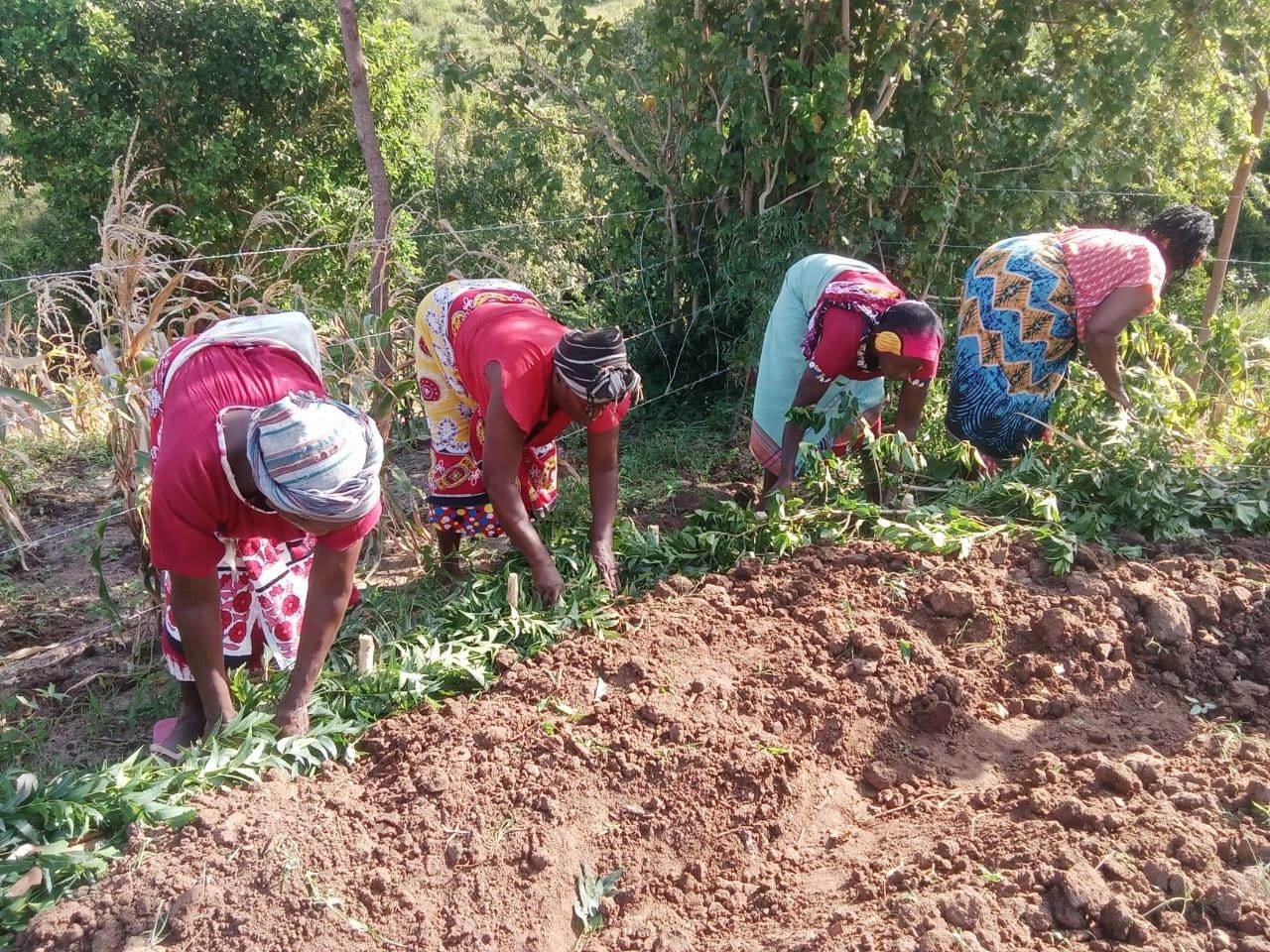
Four women are bent over broad beds in a Kiriba field. They lift green biomass, lay it in long rows against the red-brown earth, and work their way along the contours together. Around them are maize, trees, and a simple fence to keep the goats out.
This is where our data begins.
In Kiriba, we do not begin with a dashboard. We begin with the work: a fence that needs repair, maize ready for husking, a wall to be plastered, a garden exposed to livestock, water running too quickly across a farm, or a neighbor who has a plan but not enough money to begin alone.
Then people gather. They bring hands, time, tools, food, knowledge, commitments, and sometimes credit. The numbers come later, as a record of this coordination.
We write this with quiet pride as the Grassroots Economics team based here in Kiriba Village. The wider network continues to grow across Kenya and in other parts of the world. Alongside that growth, there is a particular pleasure in being able to focus deeply on our own community: to remain present for the next fence, the next training follow-up, the next repayment, and the next season. It is a pleasure to be here as a family and as a community.
Mweria, alive and changing
Mweria is a local practice of rotating shared labor. A group works first on one member’s need, then another’s. The task may be preparing land, repairing a home, processing a harvest, digging a water catchment, making makuti, or caring for a shared place. The value moves because people keep showing up for one another.
Across Kiriba, five neighboring groups of roughly fifteen members have been reviving and adapting this practice. In active weeks, they can organize five to ten collective activities among them. Mnyumbuni has also become a shared center: a place for demonstration farming, soil and water work, beekeeping, food preparation, meetings, and learning.
The reports carry the texture of this economy. They record kupukusa mahindi, husking maize; preparing syntropic beds; mulching; tilling around cassava and palms; making fences; repairing mud walls; digging a septic tank; arranging a shop; planting trees; checking bees; cleaning common spaces; and gathering to plan the next Mweria cycle.
These are not separate projects placed beside community life. They are community life. Mweria is the social rhythm that lets one household’s need become shared work, then carries that shared capacity onward.
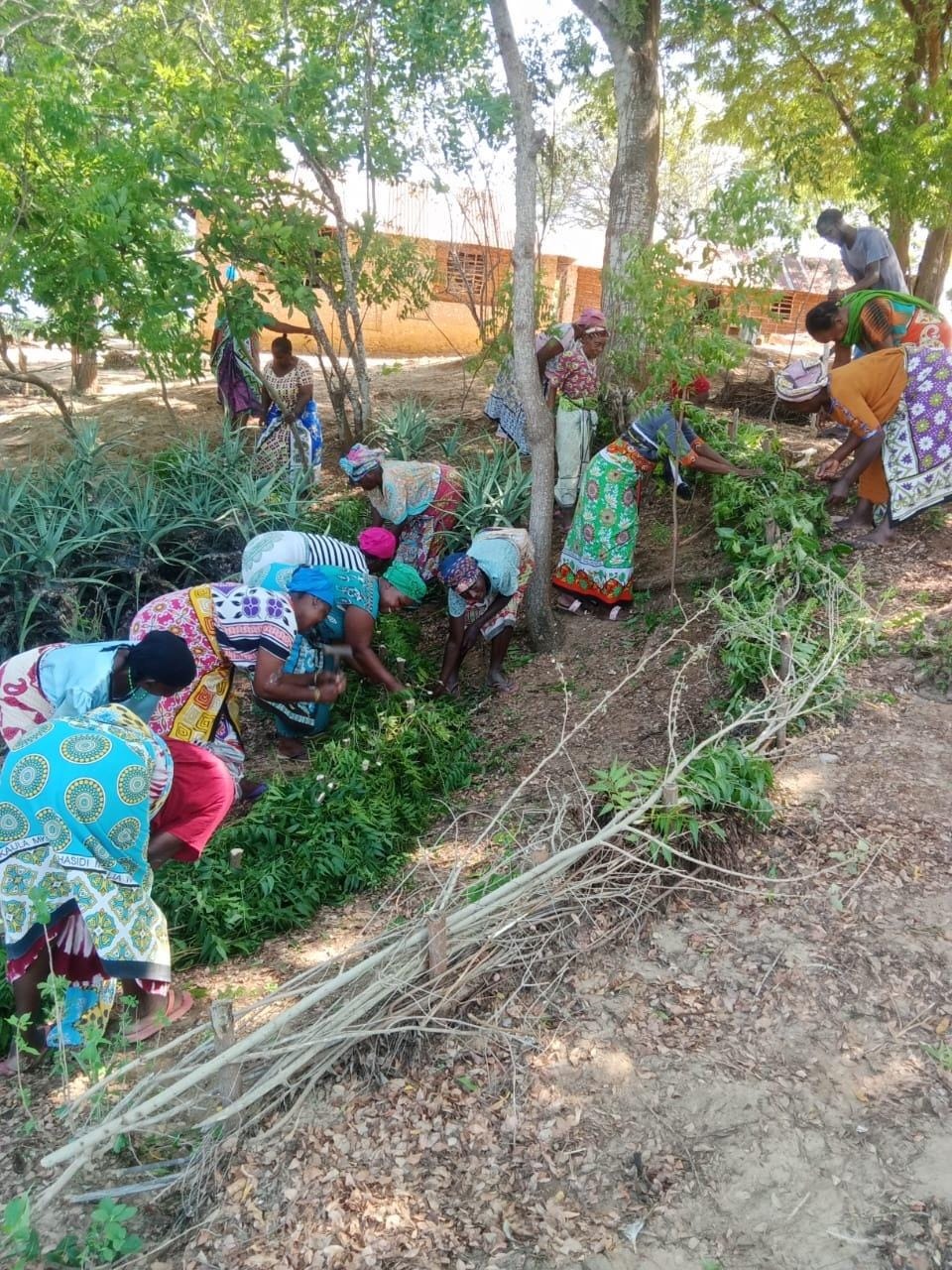
The pools do not create Mweria. They help groups remember, coordinate, and extend what Mweria already knows: that labor, trust, and care become more useful when they can circulate.
A fence is more than a fence
One follow-up report makes this very concrete. It documents fifteen members across Upendo Kiriba, Mnyumbuni, Kiriba, and Neema who each received a KES 5,000 loan for farm improvement. Together, this was KES 75,000.
The money became poles, wire, holes in the ground, repaired boundaries, and protected growing space. One enclosure measured about 30 by 40 and held seven prepared beds. Across the farms, members were establishing fruit trees, Mombasa grass, sweet potatoes, maize, kunde, vegetables, cassava, bananas, groundnuts, pumpkins, and eggplant.
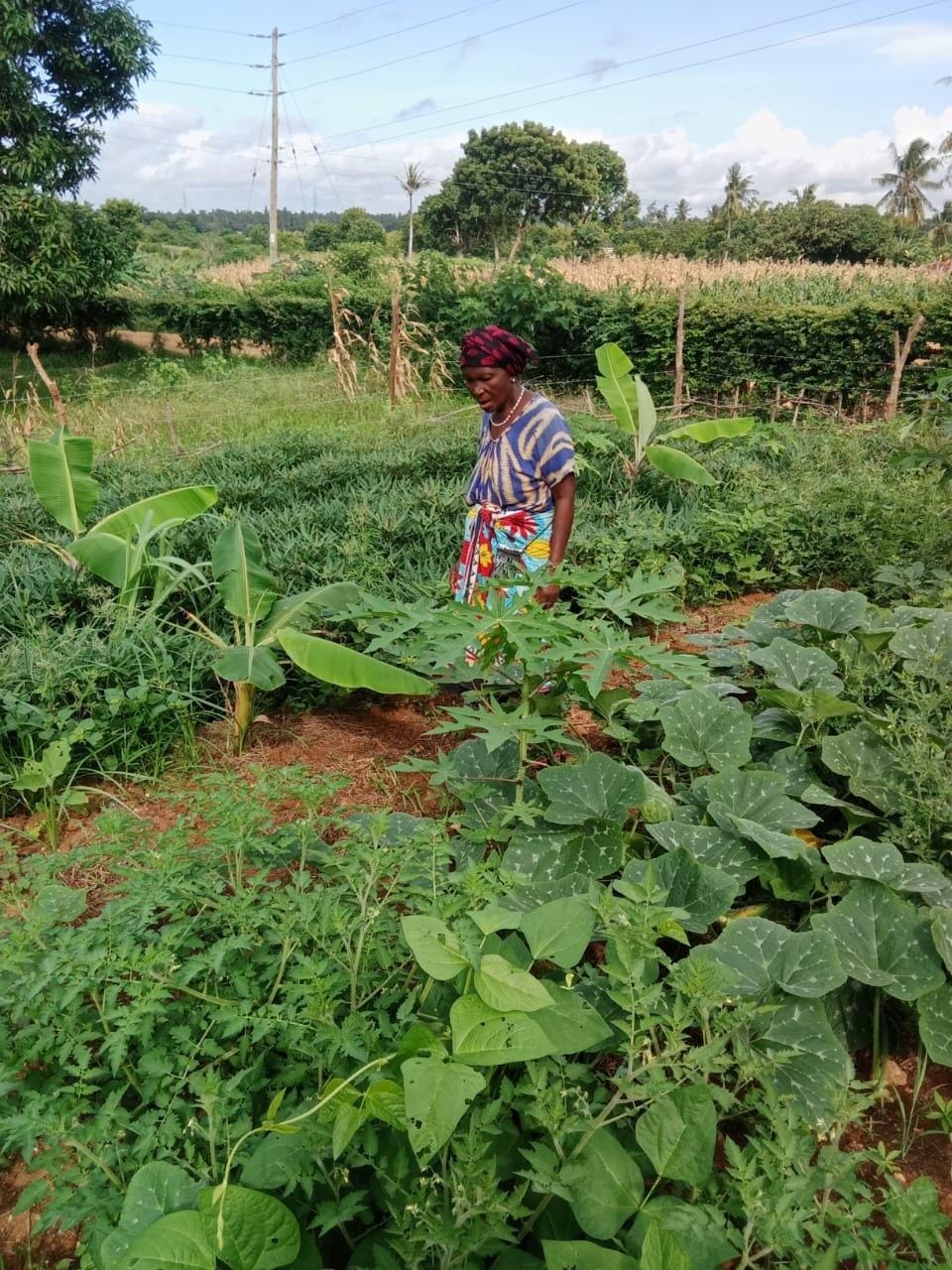
At the moment captured by that report, KES 12,000 had been repaid and KES 63,000 remained to be repaid. We include this because regenerative economics is not a story in which every commitment is instantly complete. It is the work of making useful credit available, following it into the field, and keeping repayment visible without separating it from the conditions that make repayment possible. Plans recorded in the report included repaying in small installments and using income from mandazi making and tailoring.
A fence is therefore more than wire and posts. It protects seedlings from livestock. It makes a kitchen garden possible. It gives a small loan a physical form that can keep producing food. It is also an unfinished commitment between the borrower and the group.
This is what pooled resources can do when finance stays close to purpose.
Learning that travels from one farm to another
The reports show the next part of the cycle. After a training credited in the report to Betty Wilson, each participating trainee received one kilogram of sesame seed. The team returned to document what happened after the training rather than treating attendance as the result.
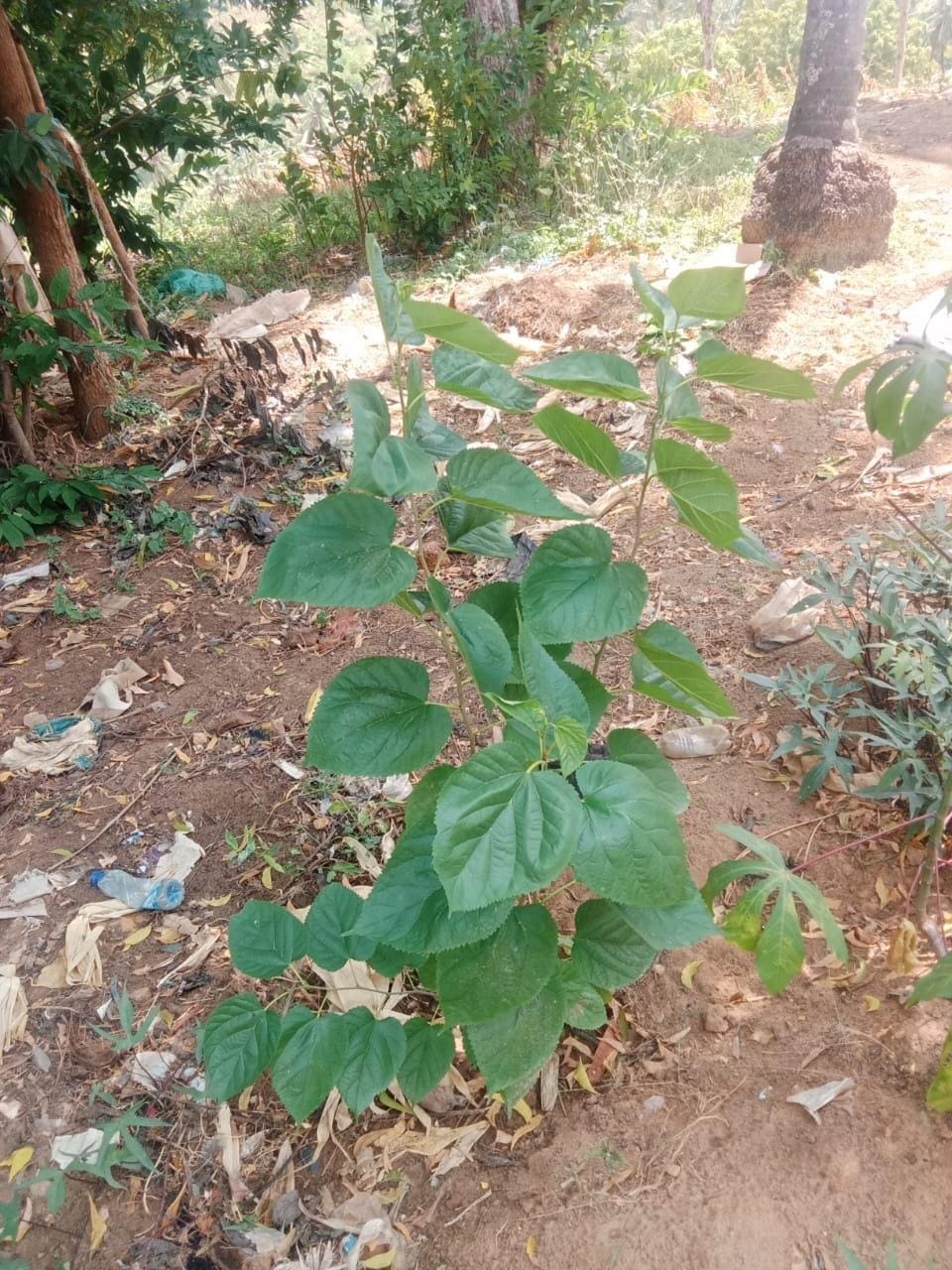
The photographs show sesame at two weeks, one month, and three months. They also show banana and mulberry seedlings at later stages. Members protected young plants with wooden fencing and thorny branches. On farms where maize was still standing, some members waited for harvest before adopting the new land preparation. Elsewhere, Kiriba members had already reproduced contour beds and terraces designed to slow runoff, reduce erosion, improve infiltration, and retain water in the soil.
Most importantly, members were helping one another do it.
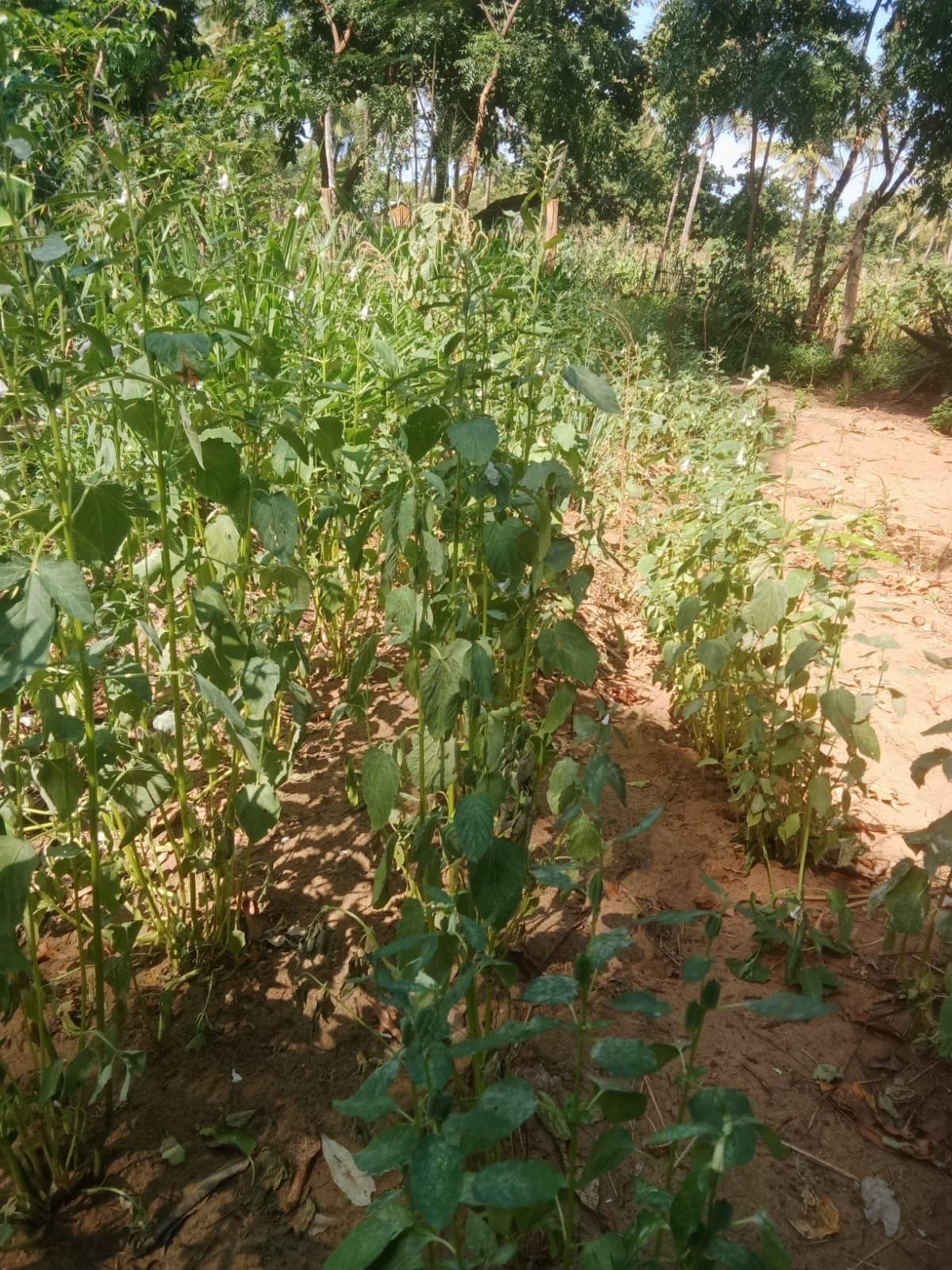
This is how a technique becomes local knowledge. It is introduced, tried, observed, adjusted to the farm calendar, and repeated with neighbors. The report does not claim that every planting succeeded or that follow-up is finished. It recommends continued mentorship. That humility matters. A training is an opening; practice is the evidence.
Six pools, connected without becoming the same
Alongside Mweria and the group lending, six commitment pools now help organize exchange around Kiriba. The Mnyumbuni community pool became operational in June 2025. Five neighborhood pools followed in January 2026: Mnyumbuni Chama, Neema Chama, Nguvu Kazi Chama, Kiriba Chama, and Upendo Kiriba.
A community voucher is a commitment from a person or group to provide value. A pool holds a curated list of vouchers that it accepts. Members can deposit accepted vouchers and swap one accepted commitment for another. They can also transfer vouchers directly in ordinary exchange.
The word curated is important. A local marketplace is not simply opened to everything. Each pool can define the commitments that belong inside it. At the same time, some vouchers are accepted by more than one pool. Those shared vouchers become bridges between marketplaces.
As of 6 August 2026, the pools contained 166 voucher memberships representing 138 unique vouchers (commitments for goods and services). The difference is overlap: some vouchers belong to several pool lists, and two are shared by all pools. This allows groups to remain locally governed while still opening routes between one another.
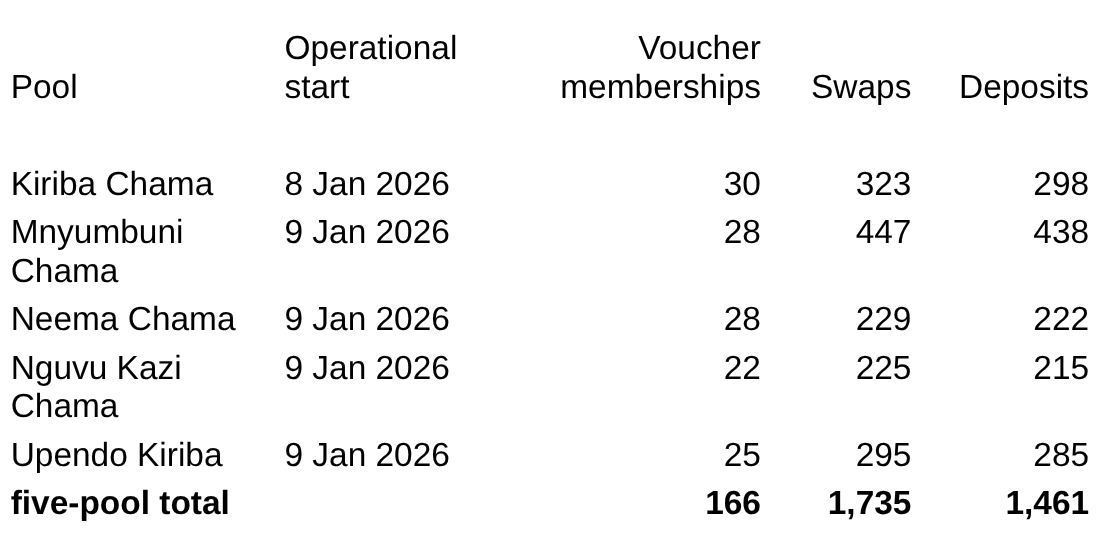
Beyond activity inside the pool contracts, the 138 vouchers recorded 15,204 direct transfer events in 11,791 transactions after the relevant pools began operating. These transfers show commitments circulating in the broader voucher network, not only being swapped inside the six contracts.
This is a marketplace made of relationships. A commitment can begin with one member’s produce, labor, goods, or service; enter a group pool; connect through a shared voucher; and become useful elsewhere without dissolving the local agreement from which it came.
What the reports show
The ledger tells us that commitments moved. The field reports help us see what that movement accompanied.
Across all history, 526 unique reports are linked to vouchers now associated with these pools. Of these, 192 are dated on or after at least one associated pool became operational. Because a voucher can be shared, one report may be relevant to several pools; the 192 figure is deduplicated.
The most frequent tags in those post-start reports are revealing:
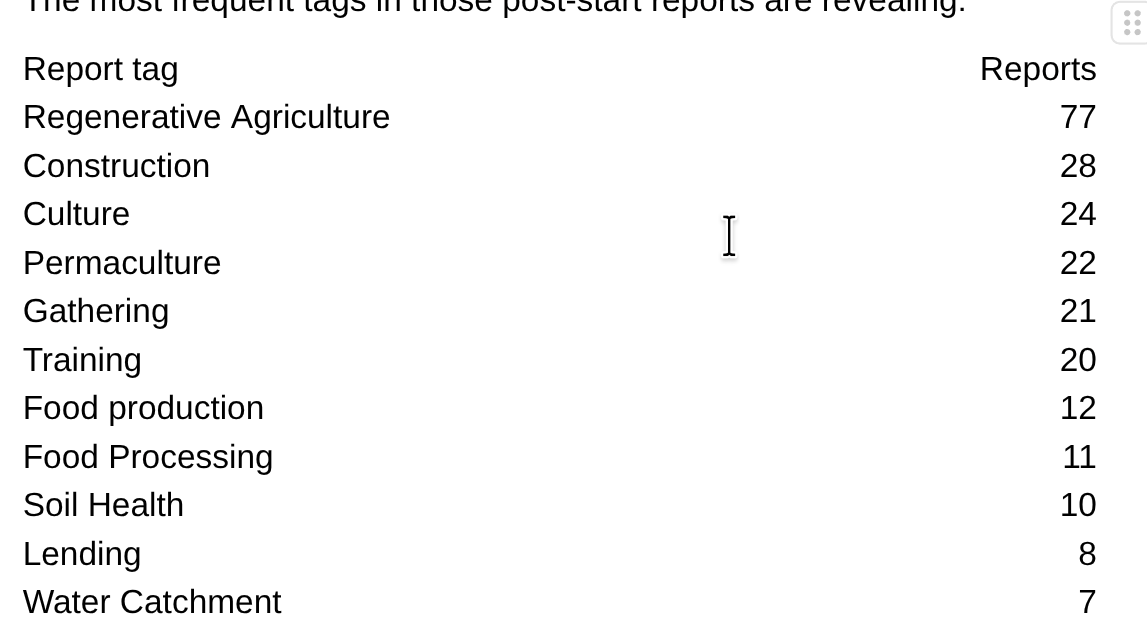
Tags can occur together on the same report. That overlap is part of the point. A day of making a contour bed can be regenerative agriculture, soil health, water catchment, training, and Mweria at the same time. A community kitchen can be food processing, care, culture, and a marketplace. A fence can be construction, food production, credit, and ecological protection.
Reports also contain 3,408 structured elapsed activity hours since pool start. Thirty-nine training-related reports account for 1,200 structured training hours. These are report-period hours, not person-hours, and reports without valid start and end times do not contribute hours. They should be read as evidence of sustained documented periods, not as a complete valuation of everyone’s labor.
The on-chain activity touches 1,935 blockchain addresses across direct transfers and pool initiation. These are accounts, not 1,935 verified individual people. One person can use more than one address, and an address can represent a group or service. We are careful about this distinction because technology can make participation appear more precise than it is.
The same care applies to value. Different vouchers represent different commitments and units, so we do not collapse all transfers into one monetary total. The strongest evidence comes from reading the layers together:
the pool records show repeated deposits and exchanges;
direct transfers show wider circulation;
activity reports show repeated work and learning;
loan follow-ups show resources becoming fences and gardens;
photographs show contours, crops, seedlings, and people working together over time.
No single layer proves regeneration. Together, they make the process visible and accountable.
An economy designed around return
From June 2025 onward, the reports show an evolution. The first phase centered on the Mnyumbuni hub: building infrastructure, gathering, culture, demonstration farming, soil and water work, nurseries, beekeeping, and training. In early 2026, the neighborhood chama pools added a more distributed layer of rotating labor, lending, farm preparation, household gardens, food processing, and local exchange.
Now the learning moves in both directions. People come together at Mnyumbuni to learn and coordinate. They carry techniques back to household farms. Groups help one another put those techniques into practice. Their vouchers and commitments circulate through local pools. Experience then returns to the next training, the next Mweria cycle, and the next lending decision.
This is what regenerative economics means to us in practice. It is not only financing an environmental activity. It is designing exchange so that value can return to the soil, return to useful work, return to a borrower as productive capacity, and return to the group as a repaid commitment. It is ecological and social restoration moving together.
We are still learning. Fences will need repair. Some repayments are still open. Seedlings will need protection through dry periods. Training needs follow-up. Data needs interpretation, and every number has limits.
But there is also abundance here: in the hands that arrive for another member’s work, in the old practice of Mweria finding new forms, in a pool that lets commitments meet one another, in a seedling that survives, and in the trust required to lend before the harvest exists.
As our wider network grows, we are grateful for the chance to stay close to these details. We are grateful to the members who welcome follow-up visits, who record their work, who allow photographs, who teach one another, and who keep returning to the field. We are proud to be doing this from Kiriba, not as observers of community, but as part of our own family and community.
This is regenerative economics in action. It is unfinished, shared, and alive between our hands.
Data note
The aggregate figures come from the verified Grassroots Economics six-pool dataset generated on 6 August 2026. Blockchain coverage ends at 15:36:50 that day. Pool membership is based on accepted-token lists; swaps and deposits are direct pool-contract events; broader transfers exclude the six target pool contracts and are deduplicated across shared vouchers. Report counts are deduplicated, while tags may overlap. Public reporting here is aggregated and does not disclose member names, phone numbers, or member account identifiers.
The six pools analyzed are:
Mnyumbuni Chama: 0x6Fa7a3AC81d70da314c90d0b11dd07A61BE5B0Af
Neema Chama: 0xD6b8e6eb399EF8C07C0E7A249D2B46Fab6f3bB7A
Nguvu Kazi Chama: 0x5f4F3d7c1A2a7E0FE1c249a233395a430D43d9b7
Kiriba Chama: 0x1eDDD7DB55dE2214B96f2FA7b850B3BAb12AD9e2
Upendo Kiriba: 0x427A1a3a92C9f3f778B3c323b81A4F83CB051897
Mnyumbuni community: 0xefBFD3BdCFC0F487b9c23Ec2400458655161229E