
Returning the Water
How communities are restoring groundwater, compounding ecosystems, and building investable water futures


This is a story about returning what we take from the Earth (beginning with water)and about how an ancient ethic of reciprocity is being translated into practical restoration, measurable groundwater recovery, and durable, investable systems that can sustain care over generations.
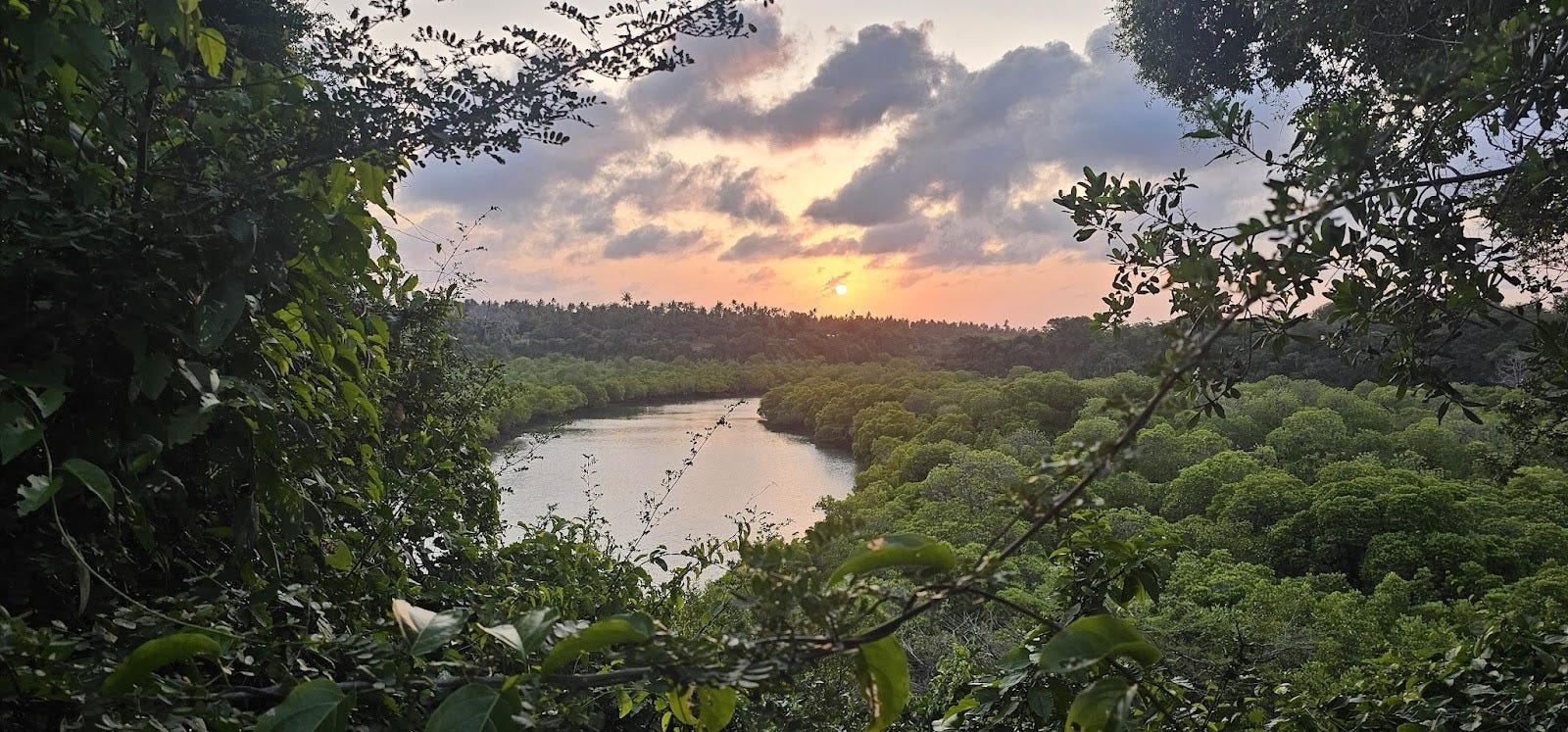
Water has never truly been something humans own. Across cultures and centuries, it has been understood instead as something borrowed, received as a gift that carries an obligation to return it - cleaner, slower, more abundant than before.
Among many Indigenous peoples of North America, this ethic is sometimes summarized as the Honorable Harvest: take only what is given, take only what you need, and give thanks through action. As Potawatomi botanist Robin Wall Kimmerer writes,
“In return for the gifts of the Earth, it is our responsibility to give gifts in return.”
Water taken for life is repaid through care for springs, rivers, and wetlands, so that the next generation may drink as well.
In the Andes, Quechua and Aymara communities speak of ayni—reciprocity not only between people, but between people and Pachamama. Water drawn for crops is returned through offerings, terrace maintenance, and watershed care that keep the land alive. In Aotearoa New Zealand, Māori principles of kaitiakitanga frame water as a relative rather than a resource: use is inseparable from guardianship, and taking without replenishing is a breach of relationship.
These are not romantic metaphors. They are practical systems. In acequia communities of the American Southwest, the right to draw irrigation water has always come with the obligation to maintain canals together. In Bali’s Subak system, water temples coordinate entire watersheds so that upstream and downstream users thrive together. Drink the water, grow the food—but show up every year to keep the system alive.
The principle is simple:
Access to water is inseparable from responsibility for the watershed.
Access without responsibility is extraction.
Access with responsibility is relationship.
At Grassroots Economics, we understand this lineage as an instruction. If we take water from the earth, our commitment must be to return it .. not symbolically, but measurably.
This commitment is especially urgent in Kilifi where Grassroots Economics is rooted, where decades of deforestation, pumping from aquifers, soil compaction, and fast runoff have lowered water tables and intensified drought-flood cycles. When soils are bare and compacted, rain becomes runoff. When rain becomes runoff, springs weaken. And when springs weaken, everything else (food, health, livelihoods) becomes harder to hold.
For years, we have worked with communities on practical steps, earth bunds that slow water, grants-supported labor for restoration, and retention landscaping that allows rain to sink back into the soil rather than rush away, guided by the ecosystem stewardship work of Aude Perronne, who has helped “returning the water” become a daily practice. These efforts matter deeply, grounding care in shared labor and local knowledge.
“Restoring water is a commitment over time, between people and the land. When we slow down, protect, and care for the landscape, the land responds by holding rain, feeding soils, and returning water to people, plants, and aquifers year after year. Stewardship is this ongoing exchange, where what we give to the land determines what it can give back.” - Aude Péronne
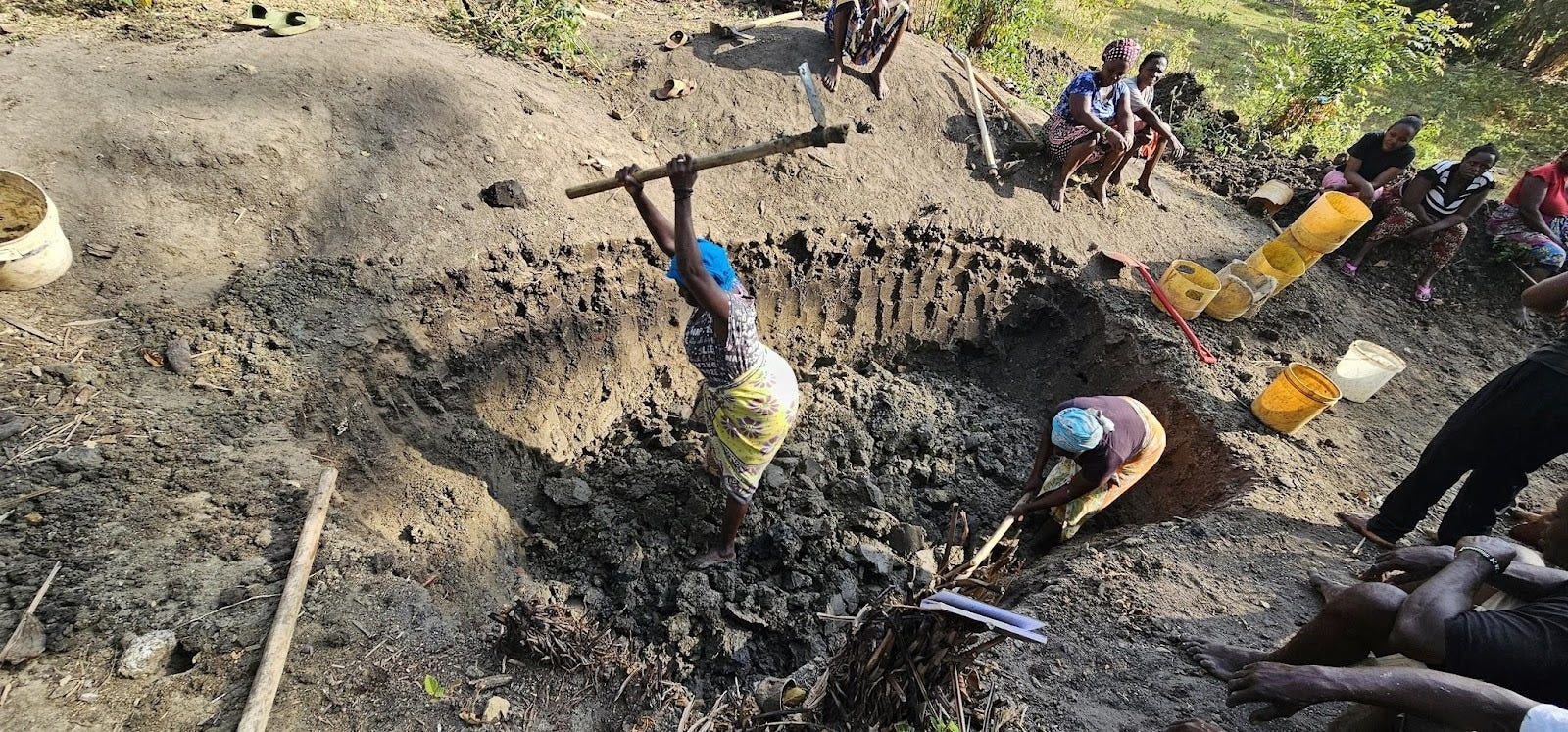
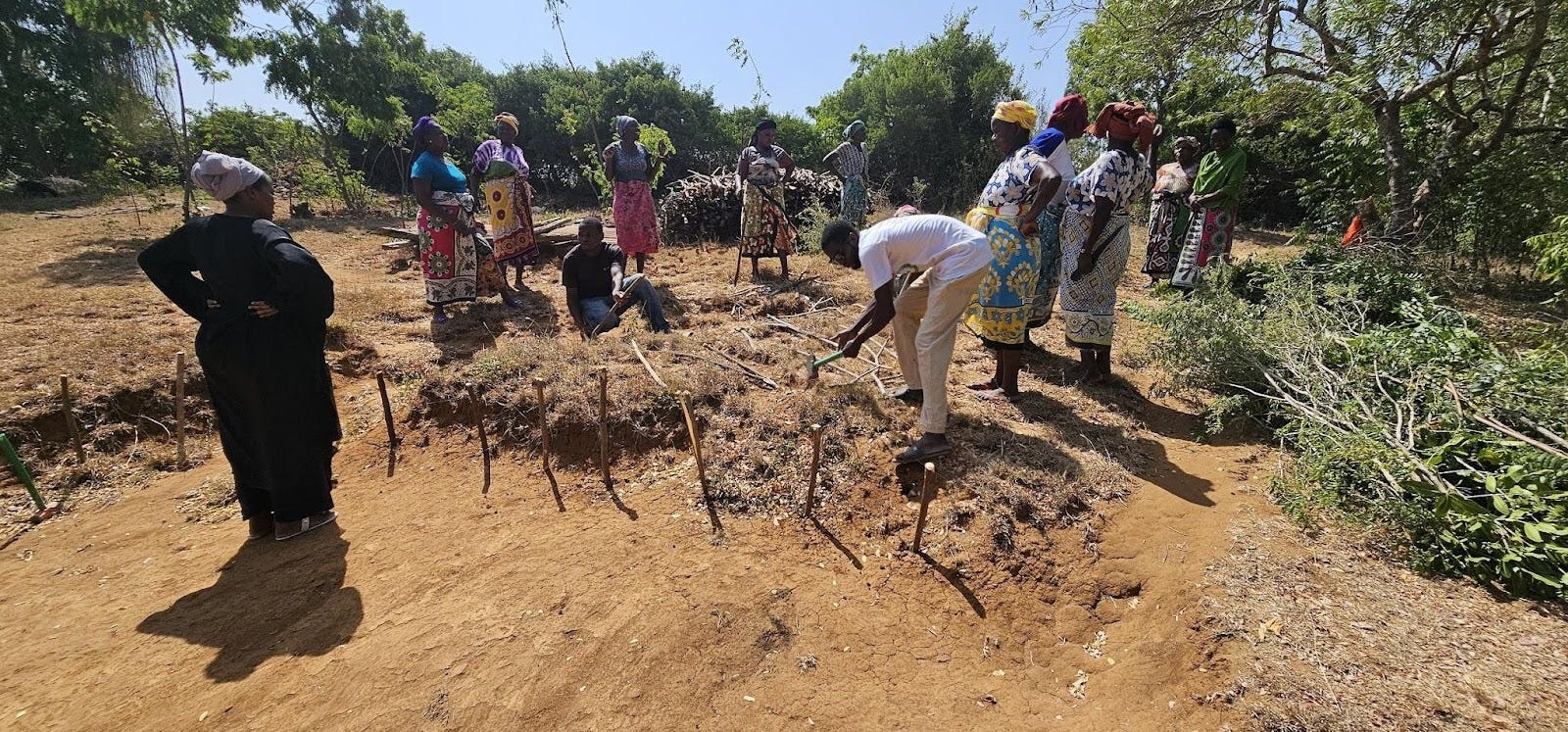
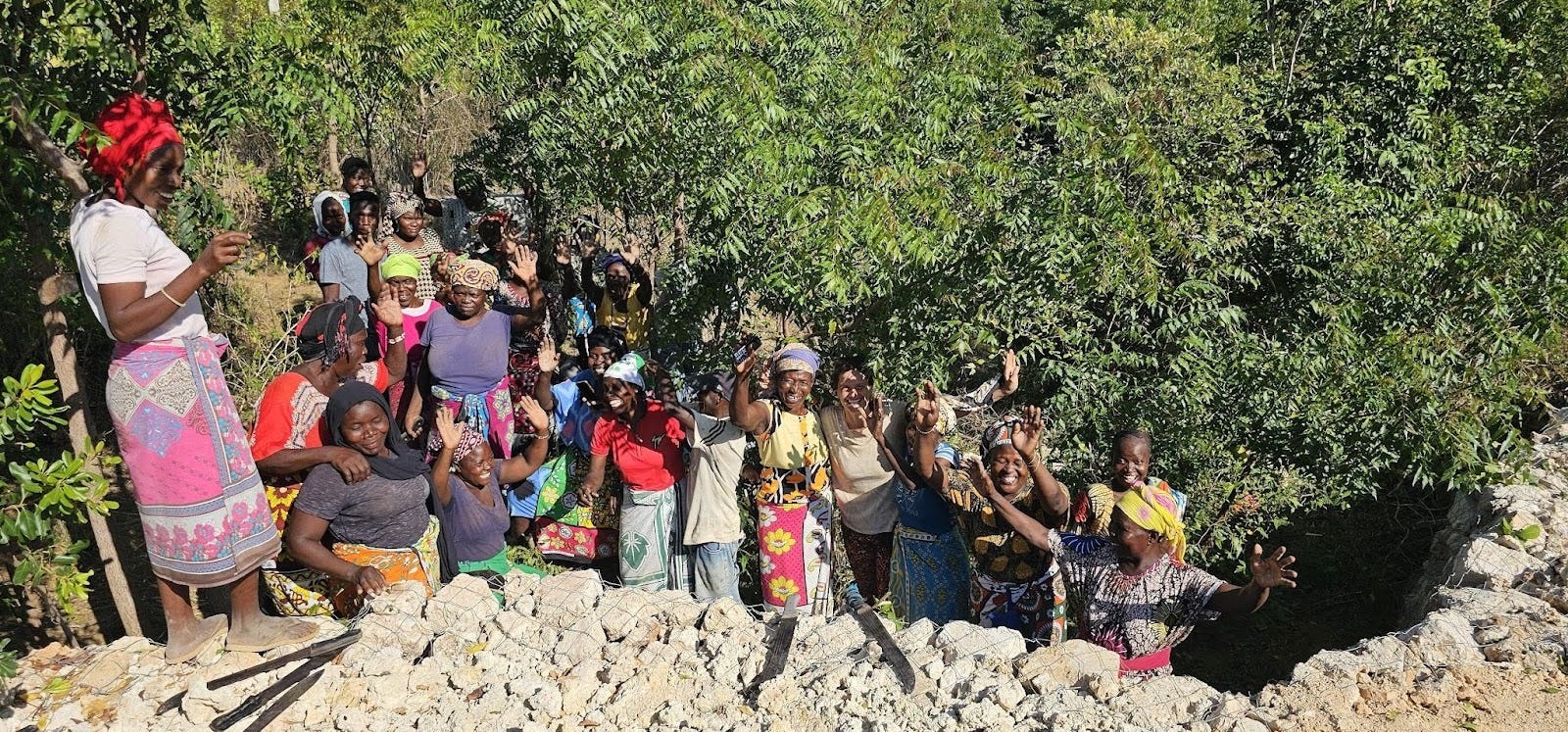
With guidance from our advisors at PSKL – Water For All, a team focused on active rehydration and unpowered restoration technologies… we are now engaging with a far more ambitious possibility. PSKL’s work demonstrates, with field evidence, that -
Groundwater availability can be increased by (more than) 100% per year
through active rehydration strategies. This is an extraordinary claim, and it comes with an equally serious responsibility to implement it carefully, transparently, and at scale.
Because this claim is so significant, we are treating it as both an opportunity and a responsibility. Our work in Kilifi will establish clear baselines (groundwater depth, infiltration performance, vegetation recovery) and publish simple, repeatable monitoring so neighbors, partners, and investors can see what is changing over time. If we are serious about doubling availability, we must also be serious about evidence.
For those who want a visual overview of this approach, we’ve shared a short explainer here:
Active vs Passive Rehydration
PSKL challenges the assumption that regeneration must be slow and passive. Many conventional rehydration and regeneration strategies are passive. Adding unpowered technologies in design enables new possibilities to optimise infiltration timing, fuelless pumping, and new possibilities for catchment methods.
By integrating unpowered technologies into landscape design—structures that optimize infiltration timing, enable fuelless pumping, and expand catchment efficiency—they show how water itself can begin to compound. As they put it,
PSKL challenges us to imagine:
“What does a dry ecosystem look like if you can increase water availability per unit area by 100% in each rain year? What would it look like in five, thirty, or a hundred years?”
This compounding is not only about water volumes. As rehydration progresses, soil infiltration rates improve, groundwater quality rises, nutrient cycles accelerate, fungal and plant networks become dramatically more efficient, and even atmospheric processes (such as cloud formation) begin to shift. Carbon matters, but it is not the only driver of climate. Water cycles, soils, forests, and aerosols are part of a deeply interlinked Earth system. When land is rehydrated, climate resilience follows.
We haven’t lost water on Earth—we still have roughly the same amount of water we’ve had for eons. What has changed is where that water is and how it moves. As the atmosphere warms, it can hold more moisture, which builds up until it’s released in extreme precipitation events. At the same time, sea levels are rising, meaning we have more water concentrated in the oceans and the atmosphere.
On land, however, we see scarcity and growing deserts, largely through human influence. Nature’s mechanism for moving water from ocean and atmosphere back onto land has always been living ecosystems (especially forests) that enable evaporation, cloud formation, rainfall, infiltration, and soil productivity. When those systems are degraded, the water cycle breaks locally, even while the planet as a whole still has the same water.
- Steve Boniwell, Co-Founder, PSKL – Water For All
In other words, the crisis is rarely about absolute supply. It is about distribution, timing, and land function. Water accumulates where it causes harm (floods, storms, rising seas) while disappearing from the places where people and ecosystems depend on it. The work of rehydration is therefore not about creating water, but about restoring the living systems that allow atmospheric and ocean water to return to land in slow, productive, and life-supporting ways.
In Practice
We are beginning this work with our neighbors around the Mnyumbuni hub in Kilifi and looking for more partners. We are fully aware that while the actions are local, the implications are global. When water is restored here, it does more than support one community. It stabilizes food systems, strengthens livelihoods, and regenerates ecosystems - - and, taken together across landscapes, it contributes to restoring hydrological balance in a warming world.
Our near-term commitment is to increase infiltration where rain falls, slow runoff before it escapes the land, restore vegetative cover that protects soils, and track groundwater recovery over time in and around Mnyumbuni. This work is grounded in observation and measurement, so that what proves effective can be shared, adapted, and taken up by neighboring areas.
As these efforts deepen, they raise a fundamental question: how do we ensure that restored water systems are protected not just this season, but for generations? This is where economic and legal systems like land trusts become central to our future plans at Grassroots Economics.
In these land trusts, communities hold land collectively with a clear commitment to care for its water function (among other commitments). Use of land and water is therefore inseparable from repair. This shifts land governance away from short-term extraction and toward long-term reciprocity. The land trust becomes a vessel for collective memory and accountability, holding the question of water across time. Who benefited? Who maintained? What has the land given back? In this way, water restoration is an ongoing agreement between people, place, and future generations.
To make this real, we are extending our work on commitment pooling into the water domain. Water services (such as access to restored catchments, irrigation, or potable supply) can be pooled digitally and accessed only in exchange for verifiable commitments to water retention landscaping, protection, and maintenance. These commitments are formalized as vouchers and certifications on the Sarafu.Network, creating a transparent link between benefit and responsibility.
For example, access to a water service (digital credit) pool could be earned by completing certified bund maintenance, restoring a catchment line, protecting a recharge area, monitoring a well, or other exchangeable goods or services including cash - each recorded as a commitment and matched to shared benefits.
Crucially, this is not only a moral or ecological argument. For water systems to endure, they must be financially sustainable. Investment provided to water commitment pools can earn returns through usage fees, generating dividends for all kinds of financiers while ensuring long-term maintenance and monitoring. In this model, investment behaves like water itself: circulating, regenerative, and sustaining life over time.
Regeneration fails when maintenance is unfunded. If water is a long-term asset, then restoration must have long-term financing.
One-off grants, however well-intentioned, are rarely enough. They do not recharge aquifers, and they do not maintain canals. Long-term investment (patient, accountable, and tied to real ecological outcomes) is how we ensure that the promise to return what we have taken is kept, year after year.
To drink water is to enter into relationship.
Our commitment is simple, demanding, and shared with many cultures before us:
We will return what we take - more slowly, more cleanly, and more abundantly than we received it.
 | A guest post by
|
 | A guest post by
|
 | A guest post by
|
Fantastic work linking ancient reciprocity principles to measurable groundwater recovery. The shift from passive regeneraton to PSKL's active rehydration is a total paradigm flip, and tying water access directly to restoration commitments through vouchers seems like the kind of accountability loop that's been missing in enviro work. I've seen way to many projects collapse after initial grants dry up. Making restoration financially sustainable through usage fees might actually keep these systems alive long-term instead of just creating short bursts of activity.